I am aware that I have readers of many faiths and none and try to make the blog accessible to all. However, there is an important spiritual addendum to the story of my year in Iraq that completes the picture. Feel free to ignore this bit if it doesn't float your boat!
My faith is a quiet one. I certainly don't experience God speaking to me every day. There have, however, been some notable exceptions where some words in the Bible have seemed to be directed straight at me in my particular circumstances.
The first time this happened I was in Thailand working with Cambodian refugees. In my mind I had a firm career plan: I would stay just one year in Thailand (I had thought about this very much in terms of a late gap year) then return to the UK and take up the place I had been offered to study children's nursing in Edinburgh. Three months into my 'Gap Year' I began to see my plans as self-centred, realising that until then my world view had been so small. I was only just beginning to pick up the Khmer and Thai language and feel in any way useful. I recognised that one year was a short time to effect any change. My contract had an option to extend another year and I began to question myself and my motivation in life. I read a passage in the Bible that literally jumped out at me, from the book of James:
'13 Now listen to me, you that say, "Today or tomorrow we will travel to a certain city, where we will stay a year and go into business and make a lot of money." 14 You don't even know what your life tomorrow will be! You are like a puff of smoke, which appears for a moment and then disappears. 15 What you should say is this: "If the Lord is willing, we will live and do this or that."
It was as if God was saying 'You had a plan to be here for one year, but how much do you know about life? You need to leave the decision making up to me!' As the year progressed I became more sure that I should stay and volunteered for a second term. At the end of my stay in Thailand my whole career plan had changed: I knew that I would be returning overseas and needed to study midwifery, not children's nursing, to be able to respond to the enormous needs in maternal and newborn health. The midwives I had met in Thailand had so impressed me with their authoritative knowledge and I wanted to be like them.
Some months later, having returned from Thailand I was looking forward to a few years in the UK, rebuilding my energy levels, reconnecting with family and friends and learning the skills I needed for my redirected career plan. Away at a Christian conference, I prayed that I would know Jesus better and experience his power in my life. Again, a passage from the Bible(Philippians 3 verse 10) leapt out of the page and I kept hearing it everywhere I went:
'All I want is to know Christ and to experience the power of his resurrection, to share in his sufferings and become like him in his death'.
I felt God saying to me that if I really wanted to know Jesus and to experience his power to help me in my daily life, then I needed to be prepared to also suffer as he had done. I felt confused and a bit miffed. Hadn't I already suffered, giving up my career plan and spending two years living in a remote Thai village, working in a refugee camp? I asked God to show me what he meant, to make it crystal clear, and then to give me the strength to respond. That evening I watched desperate TV footage of Kurdish refugees on the cold mountains and God said 'that's where I need you right now'. I was still dubious. Could God really be asking me to do this? I talked to the leaders of my church and they encouraged me to respond. One woman wrote me a moving letter saying she had been praying about how she could respond to the crisis but had no skills and had family ties - and then I had turned up wondering whether I should volunteer. She wanted to support me financially and wanted me to be her hands in Iraq. I felt humbled. And so I went, and you can read about this in the Blog.
And I did feel in many ways that I had learned what it was to suffer. I suppose I could question why a loving God would want his child to suffer and to experience PTSD. Isn't that cruel? I don't claim to understand the divine purpose. However, I can see with hindsight how my experiences have shaped me into a better human being, aware that I am vulnerable and not invincible, aware of my physical limitations and aware that anyone can experience mental health challenges, however strong they may seem. I have realised that I don't always know what is best for me and I need to be prepared to question myself and seek guidance from others.
Right now I am doing a job that I could never have dreamed of. All of my experiences to date have given me the skills I need to support volunteers, to combine my knowledge and love of midwifery with my overseas experience, to support midwives in three countries where maternal and neonatal mortality is still far too high and to use the language skills I learned in my twenties, my skills as a clinical midwife, a midwife teacher and researcher. Reflecting on the experiences that brought me here, I am grateful to God for His leading and for all of the challenges he has laid in my path.
Sunday, 18 May 2014

A year in Iraq after the Gulf War
I have recently been reflecting on my experiences of trauma and how these have shaped my life. I am hugely grateful for the relative stability of my current life whilst recognising the inevitable long-term impact that trauma can have.
In April 1991, aged 24, I had returned home from two years working with mothers and children in a Cambodian refugee camp in Thailand and had just completed a course at the Liverpool School of Tropical Medicine. I had secured a place to study midwifery and was looking forward to a few months off to recharge my batteries and reconnect with friends and family. I went away to 'Spring Harvest' (a Christian conference held at Butlins) and, whilst watching TV in our freezing cold Butlins' chalet I was confronted with heart-breaking images of Kurdish refugees literally freezing to death on the mountains in Iraq, casualties from the recent Gulf War but also from years of ethnic cleansing by Saddam Hussein's regime. At that time I felt emotionally and physically exhausted with very few reserves but couldn't escape the realisation that I had qualifications in nursing and tropical medicine and two years' experience of working with refugees. I knew that I had the ability to respond where so many did not. Without wishing to sound pious, I also felt a strong spiritual 'nudge' and having shared this at my church I felt compelled to contact the charity I had been working for in Thailand, to ask whether they were planning a response. Six days later I left London Heathrow bound for Iraq, as part of a three-way collaboration between three different agencies. Two members of the team (Seonaid and Mel) had also been working in Thailand so it was a reunion of sorts!
We travelled through Turkey, picking up our Dutch counterparts in Ankara then flying onto Diyabikir before finally arriving in Zakho, an Iraqi town on the Turkish border, in a US army Black Hawk helicopter. Seonaid was almost obliterated by an enormous Chinook helicopter coming in seconds after we had hit the tarmac. She was saved by a US marine jumping on top of her and pinning her to the ground!
As civilians in a huge military operation we stood out amidst the khaki and beige like a sore thumb in our Millet's best pink, purple and green ski jackets and tents. It was my first experience of a war zone. Helicopters flew overhead constantly. We travelled everywhere in convoy with security radios attached to our belts and our cars - no mobile phones back in the day. The area had been heavily mined so we never left the path. We were met by Phil Chester, another Thailand veteran, and taken directly to a field where Mel, Seonaid and I were to set up a mother and child health feeding station. Military tents and camouflage netting were air-dropped by helicopter and a platoon of Italian soldiers arrived to help erect the clinic. The refugees were yet to arrive so it was all rather surreal.
We camped with the US military reserves, sharing their meals and washing facilities. We got up early to use the shower but there were still long queues. When I realised there were two showers in my cubicle I called out, inviting someone else to use the other shower if they didn't mind sharing I was answered by a deep male southern US voice saying 'OK lady, ah'm a-comin' in!' Eventually the army built a separate shower block for the civilians. The individual cubicles in the mixed-gender block had suspended canvas shower buckets that had to be filled from above then were turned on and off with a shower head like the top of a tin of talcum powder. You first had to climb stairs behind the cubicles and walk along a platform, peering over the top to find your shower bucket and fill it up. We got used to showering with a constant stream of men and women walking past at shoulder height! The loos were shared and we avoided drinking too much in the daytime so we could use the toilet at night in the dark, shining our torches at people's feet to identify the occupied long-drops.
Our clinic was soon over-run and we worked hard to rehydrate babies dying from dehydration and feed up the malnourished with a mix of dried skimmed milk powder, sugar and oil. Sometimes our intervention had come too late and a few babies died whilst waiting in the queue. Some team members left and others joined from the charity MEDAIR, including Bill, an Australian doctor, and some Aussie Nurses . Yvonne (Vonny) was one of these nurses and she stayed for several months. Together we set up a field hospital, taking over from the Dutch Army. There I learned about inappropriate aid as I spent hours sorting through out of date and unusable drugs sent by well-meaning donors. One day a huge lorry turned up in the camp with a renal dialysis machine for our hospital from an anonymous donor - we didn't even have electricity! We had to send it away.
After three months many refugees moved on and so did we, to Penjwin in the east of the country on the Iranian border. We had heard of a worse refugee crisis here and there were far fewer resources and agencies on the ground. We camped this time with UNHCR, in a minefield that had been cleared prior to our arrival. There was a roped-off 'safe' area but we banged in our tent-pegs with some trepidation. We lost many balls and frisbees across the rope, never to be reclaimed.
Penjwin, high up in the mountains above Suleimaniya, was far more isolated than Zakho and we were often cut off for days at a time with fighting in the valley. Water and food were scarce. Unable to reach any markets, my team-mates made me a 25th birthday cake with Weetabix, cocoa powder and British Army ration-pack custard, topped with grapes and night lights! The various military ration packs we had been donated were a life-saver though I could never stomach the American 'tuna a la King' MRE pouch that was just like cat food with tabasco. We ate a lot of tinned sardines and cracked wheat with cucumbers and tomato, the only things available locally. We had a local cook but later found out he was a Hepatitis carrier. Mel was medivac'd out sick and many of the team spent weeks with diarrhoea, continuing to work unless we physically couldn't. The heat was scorching and we scoured the area for branches and leaves to build shaded areas in the camp. We had some wonderful staff including Cheeman, a young woman who became a firm friend as well as our translator and spent lunchtimes teaching us how to thread our hairy legs! When the crisis settled and her family returned to the city, we spent some weekends at their house, sleeping on the roof top in middle-eastern style.
Penjwin had been blown up by Saddam Hussein in the 1980s but the shells of buildings remained and the UN provided building materials for reconstruction. We helped to re-build the local hospital and worked alongside Kurdish doctors and nurses to run clinics for the local population, recently returned to their home villages after years in Kurdish 'Collectives' (one of Saddam's tools for ethnic and urban control). Unfortunately there were many hidden unexploded mines in the ruins and the casualties were often children who liked (as always) to play in building sites. I will never forget a truck turning up at the clinic as we were just closing for lunch with the dismembered bodies of two small children in the back, women wailing and pleading with us to help. Seonaid and I felt for pulses but were powerless to reconnect heads, torsos and limbs with their wellie boots still attached. We consoled the parents as best we could then drove back to camp and ate our lunch, not talking about that incident with each other until years later, back in the UK. There were always guns everywhere; every man and many children had an AK47 and they were fired in anger and joy - and at the clouds to bring the rain. Mercifully none of us was ever shot at but we were caught in the middle of a riot one morning whilst driving to work, hundreds of people with guns pressing our car from every side, urging us to put political pressure on America to remove Saddam from power. I remember, in the midst of my fear in the crowd, laughing at a banner saying 'George Bosh No. 1'. I am still unable to handle crowds and prefer to travel by bus in London rather than the tube in the rush hour, despite the longer journey. One on trip across Turkey for R&R, Geeske (a Dutch Team mate) and I took a taxi to the airport before dawn. It was a 4 hour drive through the mountains and our taxi drivers (a man an his brother) thought we might like some 'alternative entetrainment'. They stopped the taxi and one of them got in the back with me, touching me up, whilst forcing Geeske to drive the car. Thankfully we hit out at them and they got the message, leaving us alone. I think they genuinely thought that all Western women were as overly sexualised as those on the TV and were deeply apologetic when they realised we not interest. A sobering lesson that could have ended so differently.
As summer turned to autumn we found a new campsite up a hill by a stream and the two engineers on our team, Richard and Wes, showed their true colours by capping the stream and building hot and cold water systems with running showers. A litre water bottle with holes punched in the base made an excellent shower head and Wes found a second hand mixer tap by the side of the road. They buried the water pipes deep in the ground so the shower even worked throughout the snowy winter. Genius. Romance blossomed between Vonny and Nate. The rest of us flirted like crazy with the UN staff who wooed us with alcohol brought in by diplomatic privilege! Kathy Carter and I both had guitars and we spent our evenings composing songs and poems and writing letters home to send with the next person travelling out of the country. We told and re-told jokes, getting more silly as the evening progressed. Our favourites were the 'what do you call a...' jokes, the best one being: Q'What do you call a man with rabbits up his bottom?' A 'Warren'. Imagine our response when MEDAIR introduced us to their new country director.... Warren. I couldn't look at the poor man for weeks without laughing and he never knew why!
As winter arrived some of the team stayed camping in the mountains but others moved to the city of Suleimaniya, 2 hours drive down the mountain through some breathtaking scenery, to reach out to other areas. By this stage our team had mainly moved away from health programmes to school and clinic building, though we continued to do vaccine campaigns in far villages. The local contractors were paid in Iraqi Dinars which had hugely devalued since the war. Julia, our administrator, paid the bills with used notes in black bin bags! The security situation in town was tight and we had to check under the cars each day for bombs. Wes, from Northern Ireland, was used to it and trained our guards. Saddam reputedly had spies everywhere. We never went anywhere, not even to the loo, without our radios. Rachel Lavy, a midwife, joined the team and I was so impressed with her knowledge. She and I ran a training programme for health workers undertaking antenatal care and we improvised teaching materials, making dolls and pelves out of balloons, papier mache and coathangers. Rachel shared my bedroom and we discovered she loved ironing so everyone had beautifully creased clothes!
We had sacked our cook, as so many people had been sick, so I took over the role of chef, trying to make marvellous meals out of the meagre supplies available locally, topped up with occasional supplies from a Turkey-run and the various military rations left over from the war. It was interesting to see how the different armies fed their soldiers: the British rations were full of tinned processed cheese, tinned beef and carrots, mashed potato and tinned strawberry jam. The Americans had great 'sundries' such as compressed toilet paper, hot chocolate and powdered grape cordial, as well as tiny bottles of Tabasco. The French had tins of cassoulet, the Dutch had strong coffee and the Italians had wine plus a little tot of spirits in every ready-to-eat meal! We ate surprisingly well and even tried to honour special requests such as doughnuts and lemon meringue pie, one of John Adlam's favourites. John was a UNHCR water engineer who had previously worked with our charity in Sudan. He rented a room in our house and was great to have around. He also had a landrover and contacts so got us out of many scrapes!
One evening, whilst cooking dinner, I bent down to light the oven and was engulfed by a fireball. The gas had been left on and had slowly built up. Thankfully my heavy winter clothes did not ignite and protected me from serious burns but I lost 1/3 of my hair and my eyebrows and had a very sore face and arms for a week. News of my accident reached the UN radio operators who radioed 'Juliet Charlie' (my call sign) to offer me Tango Lima Charlie (work it out!)
Towards the end of my time in Iraq I became country director for the charity at the grand age of 25, representing them at UN meetings and taking care of the team's security and well-being. Honestly, the responsibility was too much for me and I began to feel unwell. I flew home being investigated for typhoid and Gulf-War Syndrome which was the popular diagnosis at the time. I now know I was traumatised from living in a war zone and suffered from panic attacks for the following year. I couldn't get into a car in the UK without checking under it for a bomb. If I heard a helicopter or a loud bang I ran for the ditch. I couldn't drive in the dark or walk across grass - not leaving the path had been our mantra for a year. I couldn't cope with the choice in supermarkets and I couldn't be alone. We had lived as a team, sharing tents and bedrooms, never travelling alone and always alert for danger. I moved back to London to stay with my parents and asked them if I could share their room, upset when they said no! We compromised by leaving the bedroom door open. In addition to having mild PTSD I missed the team. My parents were wonderful but no one in the UK could really appreciate the year I had experienced. Society expected me to come home and get on with life. People asked me if I had had a 'nice time'. How could I respond to that? I decided I need a change of scene and applied for midwifery training in Nottingham, moving up there to do agency work in the meantime and share a flat with a friend of a friend, student midwife Emma Hime.
Emma was my saviour. She had spent a year working in Africa and understood some of my re-entry stress. She didn't mind me sleeping in her room on the camp-bed when I was having nightmares. After a while she gently encouraged me to stop starting every sentence with 'when I was in Iraq'. I went along with her to St. Andrew's church and found a community of people to help me through. The church was in the middle of the Nottinghams' red light district and the people were very real from all walks of life. No one was shocked by anything. Emma was great fun to live with and when I decided to buy a house in Nottingham she moved in as one of my lodgers.
PTSD was not well understood then, even as recently at the 1990s. The charity realised I was struggling when I turned up on the CEO's doorstep at 1am in the middle of a panic attack. They sent me on a re-entry course which was lovely but full of septogenarian missionaries returning from 40 years in the tropics and needing pension advice! Thankfully I gradually recovered and started midwifery training in Nottingham in July 1992 after working for the summer as the occupational health nurse for Pork Farms Pork Pie Factory!
I have recently been re-watching the classic 1980s Prisoner of War drama 'Tenko'. In the last series, the liberated prisoners try to re-build their lives but find it can never return to what it was before. The camp is a reference point for everything and the friendships made there are deeper than any other relationships. It strikes me my experiences in Iraq, though they could never be compared to a Japanese Prison Camp, were nonetheless a defining point in my life where I realised both how strong I was but also how vulnerable. As I have been writing these memoirs I have been shaking and have found it exhausting but also therapeutic. I hope you enjoy reading them. If you were part of the team in Iraq, please also share your memories and photos and let me know if I have distorted the truth over time!
In April 1991, aged 24, I had returned home from two years working with mothers and children in a Cambodian refugee camp in Thailand and had just completed a course at the Liverpool School of Tropical Medicine. I had secured a place to study midwifery and was looking forward to a few months off to recharge my batteries and reconnect with friends and family. I went away to 'Spring Harvest' (a Christian conference held at Butlins) and, whilst watching TV in our freezing cold Butlins' chalet I was confronted with heart-breaking images of Kurdish refugees literally freezing to death on the mountains in Iraq, casualties from the recent Gulf War but also from years of ethnic cleansing by Saddam Hussein's regime. At that time I felt emotionally and physically exhausted with very few reserves but couldn't escape the realisation that I had qualifications in nursing and tropical medicine and two years' experience of working with refugees. I knew that I had the ability to respond where so many did not. Without wishing to sound pious, I also felt a strong spiritual 'nudge' and having shared this at my church I felt compelled to contact the charity I had been working for in Thailand, to ask whether they were planning a response. Six days later I left London Heathrow bound for Iraq, as part of a three-way collaboration between three different agencies. Two members of the team (Seonaid and Mel) had also been working in Thailand so it was a reunion of sorts!
 |
| Leaving Heathrow, May 1991. Me, Dr. Paul Richardson, Mel Ringland (now Latteur) and Seonaid Robertson (now Clarke) |
We travelled through Turkey, picking up our Dutch counterparts in Ankara then flying onto Diyabikir before finally arriving in Zakho, an Iraqi town on the Turkish border, in a US army Black Hawk helicopter. Seonaid was almost obliterated by an enormous Chinook helicopter coming in seconds after we had hit the tarmac. She was saved by a US marine jumping on top of her and pinning her to the ground!
 |
| Just arrived in the Black Hawk helicopter, moments before the Chinook descended! |
 |
| Camp 3 Team just before the refugees arrived: Joy (AKA Andy Pandy), Mel, Seonaid |
 |
| The platoon of Italian soldiers building our clinic |
Our clinic was soon over-run and we worked hard to rehydrate babies dying from dehydration and feed up the malnourished with a mix of dried skimmed milk powder, sugar and oil. Sometimes our intervention had come too late and a few babies died whilst waiting in the queue. Some team members left and others joined from the charity MEDAIR, including Bill, an Australian doctor, and some Aussie Nurses . Yvonne (Vonny) was one of these nurses and she stayed for several months. Together we set up a field hospital, taking over from the Dutch Army. There I learned about inappropriate aid as I spent hours sorting through out of date and unusable drugs sent by well-meaning donors. One day a huge lorry turned up in the camp with a renal dialysis machine for our hospital from an anonymous donor - we didn't even have electricity! We had to send it away.
 |
| Camp 3 medical team with our Kurdish staff |
 |
| Camp 3 with the tents up and refugees arriving |
After three months many refugees moved on and so did we, to Penjwin in the east of the country on the Iranian border. We had heard of a worse refugee crisis here and there were far fewer resources and agencies on the ground. We camped this time with UNHCR, in a minefield that had been cleared prior to our arrival. There was a roped-off 'safe' area but we banged in our tent-pegs with some trepidation. We lost many balls and frisbees across the rope, never to be reclaimed.
 |
| Arriving in Penjwin after a long drive and pitching tents in a minefield |
Penjwin, high up in the mountains above Suleimaniya, was far more isolated than Zakho and we were often cut off for days at a time with fighting in the valley. Water and food were scarce. Unable to reach any markets, my team-mates made me a 25th birthday cake with Weetabix, cocoa powder and British Army ration-pack custard, topped with grapes and night lights! The various military ration packs we had been donated were a life-saver though I could never stomach the American 'tuna a la King' MRE pouch that was just like cat food with tabasco. We ate a lot of tinned sardines and cracked wheat with cucumbers and tomato, the only things available locally. We had a local cook but later found out he was a Hepatitis carrier. Mel was medivac'd out sick and many of the team spent weeks with diarrhoea, continuing to work unless we physically couldn't. The heat was scorching and we scoured the area for branches and leaves to build shaded areas in the camp. We had some wonderful staff including Cheeman, a young woman who became a firm friend as well as our translator and spent lunchtimes teaching us how to thread our hairy legs! When the crisis settled and her family returned to the city, we spent some weekends at their house, sleeping on the roof top in middle-eastern style.
 |
| Cheeman, our Kurdish friend and translator, threading Seonaid's legs. Cheeman is wearing my trousers. She had no washing facilities in her camp so she showered at our camp and wore my clothes whilst her own were drying! |
 |
| Julia, me, Seonaid and Geeske, dressed in Kurish clothes for a party in Zakho |
As summer turned to autumn we found a new campsite up a hill by a stream and the two engineers on our team, Richard and Wes, showed their true colours by capping the stream and building hot and cold water systems with running showers. A litre water bottle with holes punched in the base made an excellent shower head and Wes found a second hand mixer tap by the side of the road. They buried the water pipes deep in the ground so the shower even worked throughout the snowy winter. Genius. Romance blossomed between Vonny and Nate. The rest of us flirted like crazy with the UN staff who wooed us with alcohol brought in by diplomatic privilege! Kathy Carter and I both had guitars and we spent our evenings composing songs and poems and writing letters home to send with the next person travelling out of the country. We told and re-told jokes, getting more silly as the evening progressed. Our favourites were the 'what do you call a...' jokes, the best one being: Q'What do you call a man with rabbits up his bottom?' A 'Warren'. Imagine our response when MEDAIR introduced us to their new country director.... Warren. I couldn't look at the poor man for weeks without laughing and he never knew why!
 |
| Lunch at UNHCR's Camp Bravo |
As winter arrived some of the team stayed camping in the mountains but others moved to the city of Suleimaniya, 2 hours drive down the mountain through some breathtaking scenery, to reach out to other areas. By this stage our team had mainly moved away from health programmes to school and clinic building, though we continued to do vaccine campaigns in far villages. The local contractors were paid in Iraqi Dinars which had hugely devalued since the war. Julia, our administrator, paid the bills with used notes in black bin bags! The security situation in town was tight and we had to check under the cars each day for bombs. Wes, from Northern Ireland, was used to it and trained our guards. Saddam reputedly had spies everywhere. We never went anywhere, not even to the loo, without our radios. Rachel Lavy, a midwife, joined the team and I was so impressed with her knowledge. She and I ran a training programme for health workers undertaking antenatal care and we improvised teaching materials, making dolls and pelves out of balloons, papier mache and coathangers. Rachel shared my bedroom and we discovered she loved ironing so everyone had beautifully creased clothes!
 |
| Making babies with Rachel |
 |
| Rachel and I in John's Landrover, visiting a remote clinic in the snow |
 |
| Snowball fights with John Adlam |
 |
| Supper with the team in Suleimaniya |
One evening, whilst cooking dinner, I bent down to light the oven and was engulfed by a fireball. The gas had been left on and had slowly built up. Thankfully my heavy winter clothes did not ignite and protected me from serious burns but I lost 1/3 of my hair and my eyebrows and had a very sore face and arms for a week. News of my accident reached the UN radio operators who radioed 'Juliet Charlie' (my call sign) to offer me Tango Lima Charlie (work it out!)
Towards the end of my time in Iraq I became country director for the charity at the grand age of 25, representing them at UN meetings and taking care of the team's security and well-being. Honestly, the responsibility was too much for me and I began to feel unwell. I flew home being investigated for typhoid and Gulf-War Syndrome which was the popular diagnosis at the time. I now know I was traumatised from living in a war zone and suffered from panic attacks for the following year. I couldn't get into a car in the UK without checking under it for a bomb. If I heard a helicopter or a loud bang I ran for the ditch. I couldn't drive in the dark or walk across grass - not leaving the path had been our mantra for a year. I couldn't cope with the choice in supermarkets and I couldn't be alone. We had lived as a team, sharing tents and bedrooms, never travelling alone and always alert for danger. I moved back to London to stay with my parents and asked them if I could share their room, upset when they said no! We compromised by leaving the bedroom door open. In addition to having mild PTSD I missed the team. My parents were wonderful but no one in the UK could really appreciate the year I had experienced. Society expected me to come home and get on with life. People asked me if I had had a 'nice time'. How could I respond to that? I decided I need a change of scene and applied for midwifery training in Nottingham, moving up there to do agency work in the meantime and share a flat with a friend of a friend, student midwife Emma Hime.
 |
| Seonaid and I with our security radios in our bedroom in Suleimaniya as she flew home and Rachel arrived |
 |
| Emma |
I have recently been re-watching the classic 1980s Prisoner of War drama 'Tenko'. In the last series, the liberated prisoners try to re-build their lives but find it can never return to what it was before. The camp is a reference point for everything and the friendships made there are deeper than any other relationships. It strikes me my experiences in Iraq, though they could never be compared to a Japanese Prison Camp, were nonetheless a defining point in my life where I realised both how strong I was but also how vulnerable. As I have been writing these memoirs I have been shaking and have found it exhausting but also therapeutic. I hope you enjoy reading them. If you were part of the team in Iraq, please also share your memories and photos and let me know if I have distorted the truth over time!
Saturday, 10 May 2014
Episode 6: Staff Nurse Cooke!
I qualified slightly later than the rest of my set thanks to 5 weeks off with chicken pox during my training. However, I was proud to pass my finals at the first attempt and to win the Peel Prize for academic achievement (John Peel was the Queen's Gynaecologist and there is a memorial plaque dedicated to him in the Kings College Hospital chapel). We had a presentation ceremony at Normanby College (Kings' nursing school) where I received my hospital badge and silver buckle and I started working as a Staff Nurse on Ruskin Ward (Male Surgery) at Dulwich Hospital in September 1987.
I felt I had found my true vocation. I just loved being a nurse and was so fortunate to work with Sister Ferguson ('Fergie') who had a quiet, empowering leadership style. Some criticised her back-seat approach; she let her staff nurses run the ward whilst she took her own patients and worked alongside students. However, I learned to manage a ward and a mix of staff under her gentle supervision. This was very unusual in the hierarchical 1980s. I clearly remember an elderly man, admitted from a nurses home covered in faeces and pressure sores, confused and aggressive from a urinary tract infection. Fergie volunteered to look after him, as she always did the most difficult patients, and together we washed him from head to toe. I worked many night shifts in runs of 6 or 8 - these days people tend to do only a few nights together but there was a lot to be said for becoming nocturnal for weeks at a time. I slept well during the day and my body clock completely adjusted. I worked most nights with Bond, an older West Indian Enrolled Nurse with a gruff exterior and a heart of gold. She introduced herself with the classic line 'My name is Bond; Enid Bond'!
The ward was a mix of general and vascular surgery with consultants Mr. Cotton and Mr. Rennie. Many vascular patients were diabetic; most were smokers and in hospital for gangrene, losing first toes then feet and finally one or both legs due to loss of circulation. Vascular pain is dreadful and several patients were on morphine - I became an expert in administering controlled drugs and in managing diabetes whilst on this ward. Some patients were in and out quickly for a hernia repair or gastroscopy but many were long-stay, unable to cope at home and with skeleton community services. Some have stayed in my mind for thirty years. Sam, a bilateral amputee who died of Clostridium Difficile before most people had heard of it, had been a prisoner of war under the Japanese in Thailand. William, a feisty northerner who said 'Bliddy 'ell fire!' more than any other words. Fred, whose wife Gladys was a long-stay patient on a female ward. They used to meet up in the day room and chain-smoke together in their wheelchairs! Fred was aphasic (unable to speak) following a stroke, a bilateral amputee with diabetes and was doubly incontinent. He needed turning and changing many times during the night and I loved caring for him. He was so patient and gracious and it was a pleasure to make him comfortable and kiss him goodnight. He loved kissing the nurses!
There were many difficult times but we also had great laughs. At Christmas we dressed up in tinsel and red and green tights and Mr. Cotton came in to carve the ward turkey at lunchtime. We turned our cloaks inside out, red felt linings showing, and paraded round the wards singing carols with lanterns. The hospital had a May Ball and we came first to the ward in all our finery to see the patients who gave us cheers and wolf-whistles. Alison Woollas was a fellow staff nurse and we did many night shifts together, working hard and laughing harder to see us through the early hours. We made illegal toast and poached eggs in the ward's new microwave oven and spent hours devising the 'Nigel Heaton Wind Scale' in quieter moments. Nigel Heaton (now a famous liver transplant surgeon) was a good looking registrar that we all secretly fancied. He was obsessed with flatulence, constantly asking the nurses whether his patients had passed wind and how many times. The wind scale was posted on the office wall and caused great hilarity at Mr. Heaton's expense. He was a great doctor with lovely bedside manner and never minded being called from him bed at 2am for a genuine emergency.
After a year as a staff nurse I wanted to explore my dream of becoming a children's nurse and started looking for opportunities to work on a children's ward to help me make a final decision. One night shift I found a small-ad at the back of the Nursing Times looking for nurses to work with children in refugee camps in Thailand. Nothing ventured nothing gained! A few weeks later, I flew to Bangkok for my first overseas adventure and two of the best years of my life. The rest, as they say, is history!
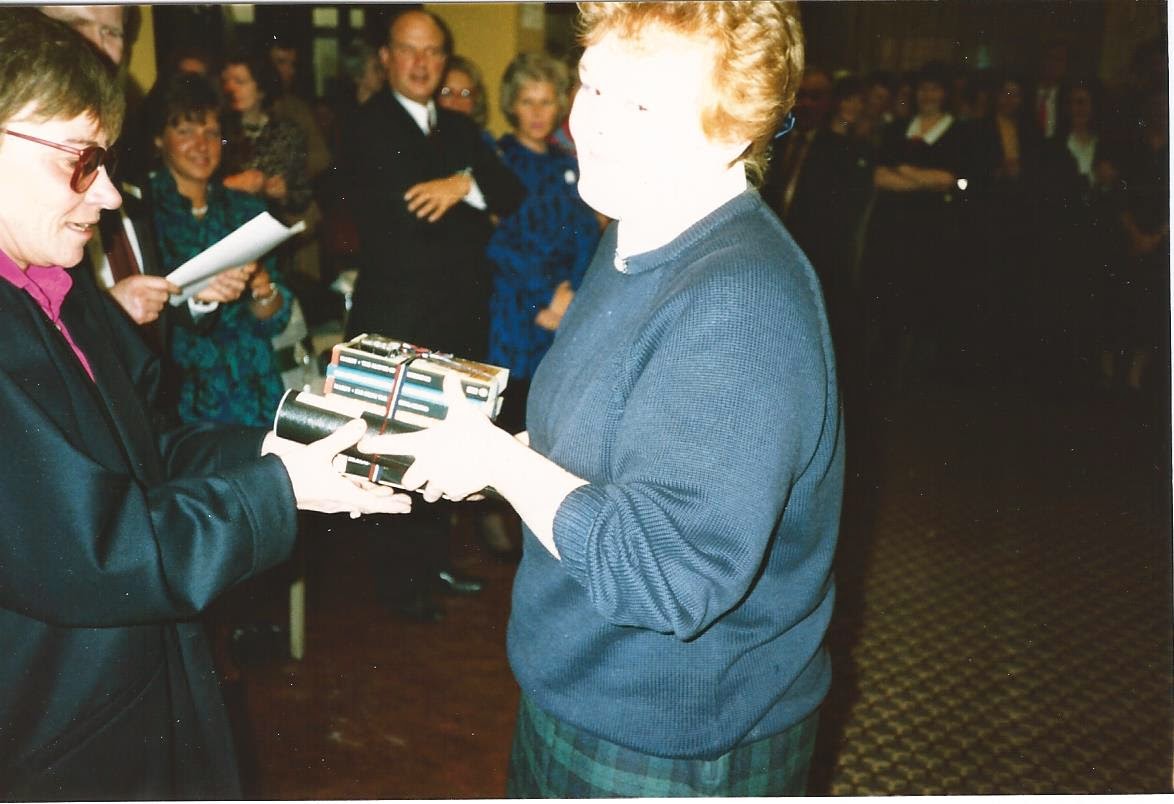 |
| Receiving my prize and certificate |
 |
| Proudly showing my Mum my certificate |
 |
| With the lovely Mrs. Hatch, our tutor, and my fellow student Linda Drewett |
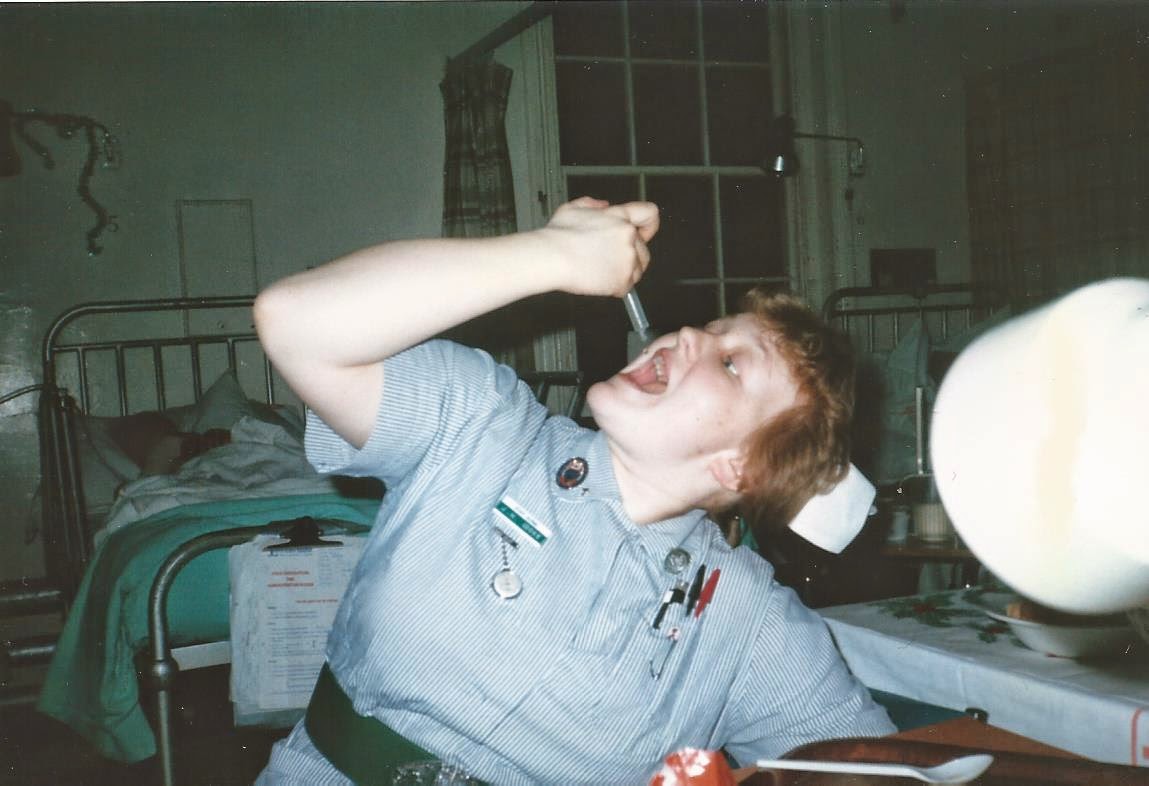 |
| I have no idea what I was doing here but it is definitely not what it seems! |
There were many difficult times but we also had great laughs. At Christmas we dressed up in tinsel and red and green tights and Mr. Cotton came in to carve the ward turkey at lunchtime. We turned our cloaks inside out, red felt linings showing, and paraded round the wards singing carols with lanterns. The hospital had a May Ball and we came first to the ward in all our finery to see the patients who gave us cheers and wolf-whistles. Alison Woollas was a fellow staff nurse and we did many night shifts together, working hard and laughing harder to see us through the early hours. We made illegal toast and poached eggs in the ward's new microwave oven and spent hours devising the 'Nigel Heaton Wind Scale' in quieter moments. Nigel Heaton (now a famous liver transplant surgeon) was a good looking registrar that we all secretly fancied. He was obsessed with flatulence, constantly asking the nurses whether his patients had passed wind and how many times. The wind scale was posted on the office wall and caused great hilarity at Mr. Heaton's expense. He was a great doctor with lovely bedside manner and never minded being called from him bed at 2am for a genuine emergency.
 |
| One crazy Christmas night with the Kardex! |
 |
| Sister Ferguson (Fergie) and Alison Woollas (right) in their Christmas finery! |
After a year as a staff nurse I wanted to explore my dream of becoming a children's nurse and started looking for opportunities to work on a children's ward to help me make a final decision. One night shift I found a small-ad at the back of the Nursing Times looking for nurses to work with children in refugee camps in Thailand. Nothing ventured nothing gained! A few weeks later, I flew to Bangkok for my first overseas adventure and two of the best years of my life. The rest, as they say, is history!
Sunday, 13 April 2014
Reflections on Uganda - March 2014
I recently spent a week in Uganda with
the RCM's director for Wales, Helen Rogers. Sadly I couldn't blog whilst
I was there as I got sick on day 2 and barely had energy to struggle through
the days let alone blog at night. However, we still had a productive trip
and were enormously encouraged by the progress made with our Global Midwifery
Twinning Project in the past year. This time we stayed with friends
rather than in a hotel: Michele and Phil Ball for the first few days then
Deborah and Phillip Betts for our last weekend. It was so nice to come
back to a home at the end of the day and for me, feeling under the weather, it
made all the difference to be able to wander out to the kitchen in the middle
of the night!
|


The
purpose of our visit was to agree a plan for the last year of our twinning
project in Uganda and to attend a workshop being run by one of our volunteers
Ann Thomson, Emeritus Professor of Midwifery from the University of Manchester.
Ann had been in country for 3 weeks, working with the midwifery
associations, universities, NGOs and others to advise on the national midwifery
curriculum and help to develop a midwifery research framework for Uganda.
Also in country were Emma Morris, a midwife from Shrewsbury on a
placement with the Uganda Nurses and Midwives Council and Zeenath Uddin, a
research and clinical midwife from London undertaking training of trainers in
life saving skills. A formidable team!
 |
| Emma (GMTP volunteer) conducting training in neonatal resuscitation with Ugandan Midwives |
 |
| Mary Gorete, President of the Uganda Private Midwives Association, saying goodbye to Professor Ann Thomson |
Helen and I had a punishing schedule of
visits to agencies and individuals connected with supporting midwifery in
Uganda, always taking a member of UPMA with us to help develop their networking
and negotiating skills. Particular highlights were visits to the Mildmay
Campus (especially the children's HIV ward, full of love and hope)
https://www.mildmay.org/overseas/uganda/ and meeting with Jean
Chamberlain and Dr. Eve from Save the Mothers, an inspirational programme
(http://www.savethemothers.org)
 |
| Mildmay are increasingly realising the value of working with midwives to address issues of sexual and reproductive health in Uganda. We had a very fruitful meeting planning how Mildmay can work with the Midwifery Association and how GMTP can support this. |
 |
| We dropped in on a local branch meeting of the UPMA in Kampala |
 |
| Me handing over some baby clothes and blankets, loving knitted by my church's new knitting club. UPMA will distribute these to mothers on International Day of the Midwife (5 May). |
Friday, 21 March 2014
A crazy week in Kathmandu
I'm coming to the end of a crazy week in Kathmandu. I've loved staying in the 'At Home' guesthouse http://www.at-home-nepal.com - it's a large family house so much more friendly than a hotel and the other guests are really interesting - German, British, Swedish and Nepali. We all sit around the breakfast table and I enjoy the sharing of experiences and ideas. The only down side is that our volunteers are staying on the other side of town but we've still managed to share several meals together and meet up during the day. There is a yoga class on the rooftop several mornings a week and some participants stay for breakfast so there are lots of interesting people to meet.
Asha, Fiona and Hilary are on a four week placement helping to 'upskill' Nepal's midwife teachers so that they will be able to deliver the midwifery education curriculum once it starts. They have prepared and delivered a fantastic programme including leadership. All participants (including me) did the Myers Briggs Personality Test and I was surprised that my profile had changed considerably since I first took the test in the 1990s. I'm a lot more T and J than I used to be! I gave a short presentation to the workshop today about the Global Midwifery Twinning Project and enjoyed showing photos from all three countries and talking through some of the challenges midwives are facing. The Nepalese midwives were so interested in what their sisters are doing across the world.
 |
| Me with our three midwife volunteers: Asha (Senior Lecturer in Midwifery, England); Fiona (Head of Midwifery, England); Hilary (Lead Midwife for Education, Scotland) |
 |
| Planning their ideal birthing rooms. and thinking about small changes they could make right now to improve the environment for birthing women |
 |
| Role playing birth in upright positions. They were fascinated (and we had a lot of fun!) |
Today I attended a Human Resources for Health workshop in the 5 star 'Yak and Yeti' Hotel http://www.yakandyeti.com/home/index.php - take a look at the website, it's an incredible place It was a shame we couldn't stay for lunch! It was a great opportunity to network with health ministers, heads of professional associations, Deans of Universities, NGOs and other agencies and do some advocacy on behalf of the Midwifery Society of Nepal. Hopefully the Universities will soon agree to deliver the midwifery curriculum - but everything here is entrenched in stultifying political red tape. It's very frustrating.
I had meetings with UNFPA, Ministry of Health and Nursing Council representatives in the afternoon then took the volunteers out for dinner this evening, together with a British Midwife living here in Nepal and her lovely 12 year old daughters. Tomorrow is meetings and project plans before leaving for the airport at 6am on Sunday morning - and doing all of this again in Uganda next week!
Tuesday, 18 March 2014
Back in Nepal again
I'm currently on a flying visit to Nepal for just a week. Next week I go onto Uganda and in April I'll be back in Cambodia.I'm here with the RCM's Global Midwifery Twinning Project (now two thirds complete) to ensure we have a clear direction for the remaining year of the project in Nepal, to meet our RCM volunteers and other RCM members here, to plan for our partner's forthcoming trip to Prague and the UK, to meet all the people involved in the project and the external stakeholders and to plan for the future after GMTP. That's a tall agenda in under a week!
I arrived last night and was delighted to meet a friend ( a Swedish midwife working here with UNFPA) on the flight from Delhi and to be met at the airport by a driver carrying a sign with my name on it. It's always such a relief not to have to run the gauntlet of gannet-like taxi drivers at the airport. I have an old Nokia phone with a Nepali SIM card so I topped it up at the airport - it's so important to be able to contact people here. I changed some money at the airport too - it's so easy there. I have learned from bitter experience that changing it in a bank here is very complicated and to be avoided at all costs!
I'm staying in a new place, a family-run guesthouse that's very friendly with yummy kiwi jam for breakfast and plenty of tea on tap (essential for me!) There's a new Indian restaurant just across from the guesthouse so handy for dinner. I'm having a vegetarian lent and it's so easy to be veggie in South Asia, with so many delicious veg curries.
It's been a very busy first day in-country. A very important meeting at UNFPA first thing, talking about how we can support each other's work in midwifery capacity building. Their midwifery advisor leaves her post soon so our continued input will be especially welcome. Then onto the new National Health Training Centre for a 5 day midwifery education workshop that our UK volunteers are facilitating, helping to bridge the gap between the nurse-midwife training currently on offer and the new midwifery curriculum soon to be introduced in Nepal . From there I went back to the volunteer's hotel for tea and to catch up with them on how their placements have been going to date. They are very senior midwives in the UK - one is a Head of Midwifery and the others are Senior Midwifery Lecturers. They are doing a brilliant job and working so well together. They have proved themselves very skilled negotiators!
This evening there was a formal reception and dinner to celebrate the workshop and network with VIPs - Deans and Vice Deans came from various universities who will be responsible for delivering the new midwifery curriculum. I also met a UK RCM member midwife who has just managed to register as a midwife with the Nepal Nursing Council despite not being a nurse. This is so exciting as it paves the way for more midwifery registration. She is a fluent Nepali speaker and we hope to stay in touch and use her as a resource. I was able to tell her about the RCM's online training tool i-learn, and it's i-portfolio. Hopefully she will find these very useful for keeping up to date as a midwife. I also met a Swedish Professor of midwifery also supporting midwifery education here: we shared experiences and made plans to keep in touch.
Back at the guest house there were many e mails to answer, including offering support to a volunteer in Cambodia struggling with her placement. There's never a dull day in the life of a Global Professional Advisor!
Tuesday, 29 October 2013
North to South
Now the Advocacy workshop is over, I am concentrating on the mid-term evaluation of our Global Midwifery Twinning Project. This has taken me out of Kampala, past the Equator, to visit midwives up-country where our GMTP volunteer midwives have been based, learning about Ugandan midwifery, providing training in Emergency Obstetric and Newborn Care and role-modelling woman-centred care.
Yesterday we visited three private midwives clinics all providing community-based midwifery services, many in remote areas currently in poverty until the rains come. All of these small centres are providing 'gold-standard' midwifery care with continuity, privacy, cleanliness, good clinical standards and geographical accessibility. However, they are often under-utilised for maternity services as women have to pay. Instead, women stay at home to deliver with a Traditional Birth Attendant, or use the government health posts which are under-resourced and under-staffed.
We visited one such government district hospital; the one doctor was overwhelmed with patients and had no time to examine them or provide proper diagnosis and treatment. As we toured the wards, an old man died in the corner died without ceremony from pneumonia. He was peripherally shut-down and staff couldn't find a vein to start the IV antibiotics he desperately needed. There was no oxygen and no nurse by his bedside. In the out-patients' department a baby, no more than 4 months old, was breathing too fast with a chest infection. He should have been admitted for intensive nursing; instead he saw the doctor for 30 seconds and was sent away. The maternity unit was quiet as the operating theatre was temporarily closed for building works. Women are referred there for caesarean section, only to be referred onto another place. One of our volunteers had donated some beds for the hospital and conducted some training for the midwives there. However, maternal mortality rates in Uganda are still rising. Political will, cultural issues and system transformation are required for sustainable change.
Today I attended a workshop with the Ugandan Nurses and Midwives Council, reviewing the final draft of their new midwifery handbook. I my presentation this afternoon I urged midwives to join together in lobbying the government to introduce free midwifery care for women at any centre with skilled birth attendants and appropriate equipment. The private midwives have so much to offer. A voucher scheme entitling women to free services would enable many more women to benefit from this gold-standard care - and save lives. Financial incentives such as these have contributed to a drastic reduction in the maternal mortality rates in Nepal and Cambodia (our other twin countries) in recent years.
I have mentioned before that Ugandan Midwives are very spiritually minded - we had four prayers today at the workshop (I am trying to imagine an NMC workshop in the UK with prayer before each coffee break...!). I decided to go with the flow and end my presentation using some words from the Bible, exhorting midwives in Uganda to work together, to be strong and courageous and not to give up.
 |
| At the centre of things - passing the Equator on Sunday |
 |
| Delivering the beds donated by one of our volunteers to a Level 4 Health Facility in rural Uganda (near Masaka) |
 |
| With Maria (UNFPA Country Midwifery Advisor for Uganda) and John (Registrar, Uganda Nurses and Midwives Council - at today's workshop |
Today I attended a workshop with the Ugandan Nurses and Midwives Council, reviewing the final draft of their new midwifery handbook. I my presentation this afternoon I urged midwives to join together in lobbying the government to introduce free midwifery care for women at any centre with skilled birth attendants and appropriate equipment. The private midwives have so much to offer. A voucher scheme entitling women to free services would enable many more women to benefit from this gold-standard care - and save lives. Financial incentives such as these have contributed to a drastic reduction in the maternal mortality rates in Nepal and Cambodia (our other twin countries) in recent years.
 |
| With Elizabeth, Rose and Jemima - all senior Ugandan midwifery educators with Masters Degrees or PhDs - at the Nurses and Midwives Council workshop today |
'Be strong and very courageous as you lead these people.. that you may have success. Do not be afraid or discouraged, for the LORD your God will be with you wherever you go'.
(Joshua Chapter 1)
The afternoon finished (after another prayer!) with over 40 midwives joining hands and singing:
It was all a bit much for this participant at the Uganda Nurses and Midwives Council Workshop

"We are together again, in one accord.
Something good is going to happen, something good is in store".
Subscribe to:
Posts (Atom)
Re-entering life in the UK after three years in Bangladesh feels like stepping into a strange, beautiful, and deeply unsettling limbo. The t...

-
 It’s three weeks today since I left the UK for Bangladesh. I’ve come out of the house for the first time in 2 days after a nasty bout of D...
-
 I’ve made it through my first week in Bangladesh! It was emotional leaving my family just a few days after the death of my wonderful mothe...
-
I haven't written a blog post in over a year... for a mixture of reasons including lack of time, respecting the confidentiality of our ...
